
How to Prevent Baseball Bat Cracking in Cold
Table of Contents
- Why Cold Weather Damages Bats Faster Than You Think
- Temperature Thresholds: When to Leave the Bat in the Bag
- Signs of Bat Fatigue: What to Check Before Every Cold-Weather Game
- The Best Way to Warm Up a Baseball Bat Before Cold-Weather Play
- How to Store Your Bat in Winter: Off-Season Storage Protocols
- Composite Bat Cold Weather Performance: What to Expect
- Warranty Implications of Cold Weather Damage
- Conclusion: Protecting Your Investment Year-Round
- Frequently Asked Questions
Last Updated: September 21, 2026
Why Cold Weather Damages Bats Faster Than You Think
Cold air makes composite and alloy bats brittle, and a brittle bat cracks far more easily on contact. This guide from Heatstik explains how to prevent baseball bat cracking in cold weather, from temperature limits to storage and warm-up routines.

Here's the core problem: bat makers build barrels to flex and spring back on impact. When the thermometer drops, that flex fades. The material stiffens, the sweet spot shrinks, and every mishit sends more shock through the barrel wall.
The Science of Ball Density in Cold Temperatures
Baseballs get denser and harder in the cold. A chilled ball loses its bounce, so it doesn't compress the way it does in July. That means the bat absorbs more of the collision instead of transferring it into ball speed.
The result is a double hit on your equipment: a stiffer bat meeting a harder ball. Impact force climbs, and the barrel takes the punishment.
Composite vs. Alloy: How Each Handles the Cold
Composite and alloy bats fail differently in cold weather.
- Composite: Resin-rich fibers stiffen and lose flex. Micro-fractures form, then spread into full barrel cracking.
- Alloy: Metal dents and flat-spots rather than shattering, but repeated cold impacts still shorten its life.
Composite bats suffer more. Their performance depends on fiber flex, and cold kills that flex fast.
Temperature Thresholds: When to Leave the Bat in the Bag
Most bat makers recommend retiring composite bats below roughly 10°C (50°F). Alloy bats tolerate colder conditions, but performance drops and dent risk rises. Treat these as general guidelines, not guarantees, and check your bat's own warranty terms, since manufacturers set their own cold-weather limits.
A more useful way to think about it is in tiers, because the risk curve is not a single cliff. The table below reflects the ranges most practitioners and manufacturer guidance converge on.
| Temperature range | Composite bats | Alloy bats |
|---|---|---|
| Above 15°C (59°F) | Normal use | Normal use |
| 10-15°C (50-59°F) | Acceptable with pre-warming; expect a smaller sweet spot | Normal use; monitor for flat spots |
| 5-10°C (41-50°F) | High risk; use a backup or training bat | Usable but dent risk climbs |
| 0-5°C (32-41°F) | Do not use a game composite | Shortened lifespan; avoid hard mishits |
| Below 0°C (32°F) | Do not use | Do not use |
Safe Usage Guidelines for Composite Bats
Follow these rules on cold days:
- Store the bat indoors until game time, never in a cold car trunk
- Warm the barrel before your first swing
- Rotate bats if you have more than one
- Avoid using your game bat for cold-weather practice
- Keep a backup alloy bat for temperatures near freezing
- Watch the ball as closely as the bat: a frozen ball is the other half of the impact equation
How Ball Temperature Changes the Equation
A baseball's coefficient of restitution, the measure of how much energy it returns after compression, falls as the ball gets colder. A ball stored at near-freezing temperatures behaves noticeably harder and less elastic than one kept at room temperature. That means the same swing at 5°C produces a sharper, more concentrated impact than it would at 25°C, and the barrel absorbs the difference.
This is why warming the ball matters as much as warming the bat. Keeping game balls in an insulated bag, rotating them from a warm cooler, and avoiding balls that have sat in an open bucket all morning all reduce the peak force the barrel sees.
Signs of Bat Fatigue: What to Check Before Every Cold-Weather Game
Inspect your bat before every cold-weather session. Early detection is the difference between a cosmetic mark and a dead barrel.
Look for these signs of bat fatigue:
HeatStik Softball Heated Bat Warmer →
- Fine spiderweb lines in the paint or clear coat
- A dull or chalky patch on the barrel
- A rattle or buzz on contact
- Any change in the sound at impact
- A visible seam or ridge near the taper
Visual Inspection Guide for Micro-Cracks
Micro-fractures show up before full cracks do. Run your fingertips along the barrel in good light, and tilt the bat so light rakes across the surface. Hairline marks that catch the light are early fiber delamination.
The Best Way to Warm Up a Baseball Bat Before Cold-Weather Play
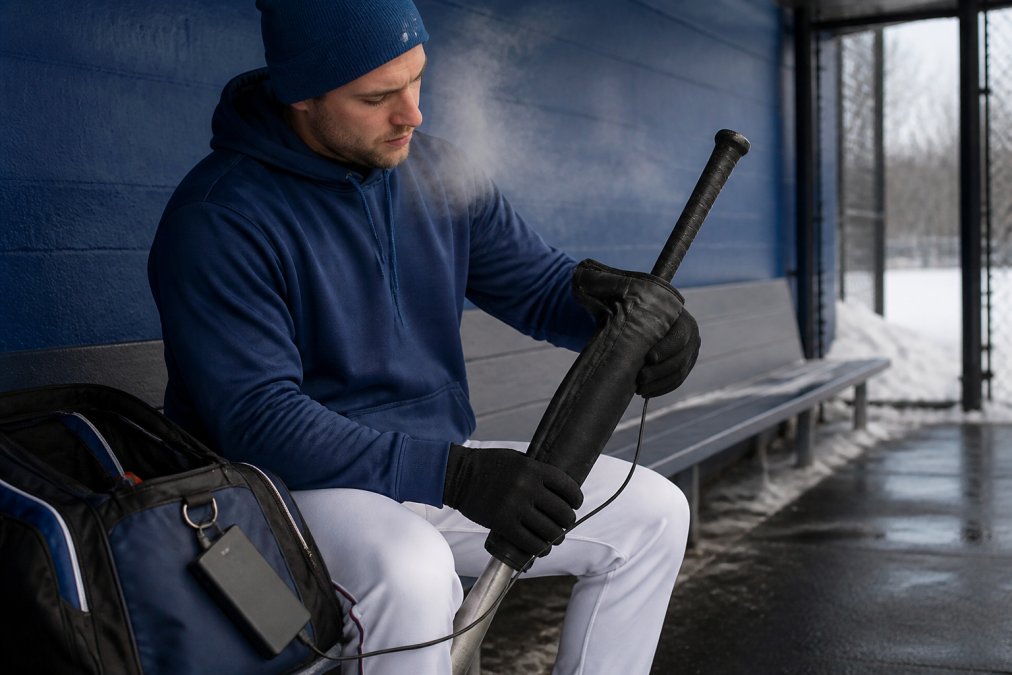
The best way to warm up a baseball bat is gradual warming before play, not a few practice swings. A bat warmed evenly to a safe range keeps its flex and holds its sweet spot.
Safe Warm-Up Routines for Equipment
Warm up the bat the same way you warm up your body: slowly.
- Bring the bat indoors at least an hour before play.
- Slip on the heated sleeve and set a low-to-mid temperature.
- Let it warm evenly for 10 to 15 minutes.
- Take easy half-swings before full swings.
- Re-sleeve the bat between innings to hold temperature.
How to Store Your Bat in Winter: Off-Season Storage Protocols
Off-season storage decides how your bat performs next spring. Store it indoors, in a stable, dry spot, and keep it out of temperature swings. Most articles stop there. The problem is that many players have no choice but to store gear in an unheated garage, shed, or basement, and those spaces are where bats quietly degrade over a winter. Here is a protocol built for exactly that situation.

Step-by-Step Off-Season Storage
- Clean and dry. Wipe the barrel with a soft, damp cloth, then dry it fully. Do not store a bat with dirt, pine tar, or moisture on the surface.
- Inspect before storing. Check for micro-cracks, spider-webbing, or a dull patch. A flaw that goes into storage can widen over the winter.
- Choose the right space. A heated, climate-stable room is ideal. If that is not possible, pick the most insulated, least temperature-swinging corner of the unheated space, away from exterior walls and concrete floors.
- Elevate the bat. Store it horizontally on a shelf or rack, not leaning against a wall and not resting on bare concrete, which wicks moisture and stays cold.
- Control moisture. Add a moisture-absorbing pack to the gear bag or storage bin and check it monthly. Replace it when saturated.
- Avoid load and contact. Do not stack heavy gear on top of the barrel, and do not store bats pressed against each other.
- Re-check mid-winter. Pull the bat out once or twice, inspect it, and confirm the storage space has stayed dry.
The Role of Humidity in Cold-Weather Damage
Humidity matters as much as temperature. Damp cold air lets moisture work into micro-fractures, and when that moisture freezes, it expands and widens the cracks. Over a winter, a small flaw becomes a dead barrel.
Composite Bat Cold Weather Performance: What to Expect
Composite bat cold weather performance drops measurably below about 10°C. The barrel stiffens, the sweet spot shrinks, and exit velocity falls even on well-struck balls.
Warranty Implications of Cold Weather Damage
Before you file a warranty claim, check two things:
- The minimum recommended temperature in your bat's paperwork
- Whether the damage looks like impact cracking or a manufacturing defect
For official guidance on equipment safety and standards, see USA Baseball bat standards and safety guidance.
Conclusion: Protecting Your Investment Year-Round
Cold weather is the hardest test your bat will face all season. Stiff fibers, denser balls, and frozen moisture all push a barrel toward failure, and no warranty will cover the damage.
Frequently Asked Questions
At what temperature do baseball bats start to crack?
Composite bats are most vulnerable below 15°C. The thermoplastic resin that binds composite fibers becomes brittle in cold weather, reducing impact resistance. Alloy bats handle cold better but can still dent. As a general rule, avoid using composite bats in temperatures below 10°C unless you warm them first. If game-time temperatures drop near freezing, use an alloy bat or keep your composite bat warm between innings.
Does cold weather affect composite bats more than alloy bats?
Yes, significantly more. Composite bats rely on resin to hold carbon fibers together. Cold makes that resin brittle, so impact force causes micro-fractures and fiber delamination. Alloy bats are more forgiving in cold, but they can develop dents and cracks from repeated exposure. If you must play in cold weather, composite bat cold weather performance drops sharply without proper warming, while alloy bats lose some pop but hold up better structurally.
How can I keep my baseball bat warm during a game?
Use a heated bat sleeve between innings. The HeatStik Heated Bat Warmer fits over the barrel and keeps your bat at an optimal temperature using a USB-powered 30,000mAh power bank. It fits bats up to 2 1/4 inches (softball) or 3 inches (hardball). Slip it on in the dugout, and your bat stays warm and responsive for every at-bat. This is far more effective than wrapping a bat in a blanket or storing it in a cooler.
What are the signs of bat fatigue due to cold weather?
Watch for a dead sound on contact, reduced exit velocity, visible micro-cracks near the barrel end, or a rattle inside the bat. Cold-weather damage often starts as small fiber delamination you cannot see. If your bat feels less responsive or sounds different, stop using it immediately. Continuing to swing a fatigued bat in cold weather can lead to complete barrel cracking and void your warranty.