
Does Temperature Affect Softball Bat Performance?
Table of Contents
- How Temperature Affects Softball Bat Performance
- Ball Compression and Exit Velocity in Cold Weather
- Composite Bat Cold Weather Damage: Material Breakdown
- Alloy Bats and Temperature: Why Cold Affects Metal Performance
- How to Warm Up a Softball Bat Before Play
- Storage and Maintenance: Preventing Cold-Induced Damage
- Frequently Asked Questions
Last Updated: September 28, 2026
How Temperature Affects Softball Bat Performance
Cold weather fundamentally changes how your bat performs. When temperatures drop, the materials in both composite and alloy bats become stiffer, less responsive, and more prone to damage. This isn't theory, it's physics. The barrel loses its sweet spot responsiveness, exit velocity drops, and the risk of structural failure increases. Understanding how temperature affects softball bat performance helps you protect your equipment and maintain consistency at the plate, whether you're playing early-season games or fall ball tournaments in cold climates.
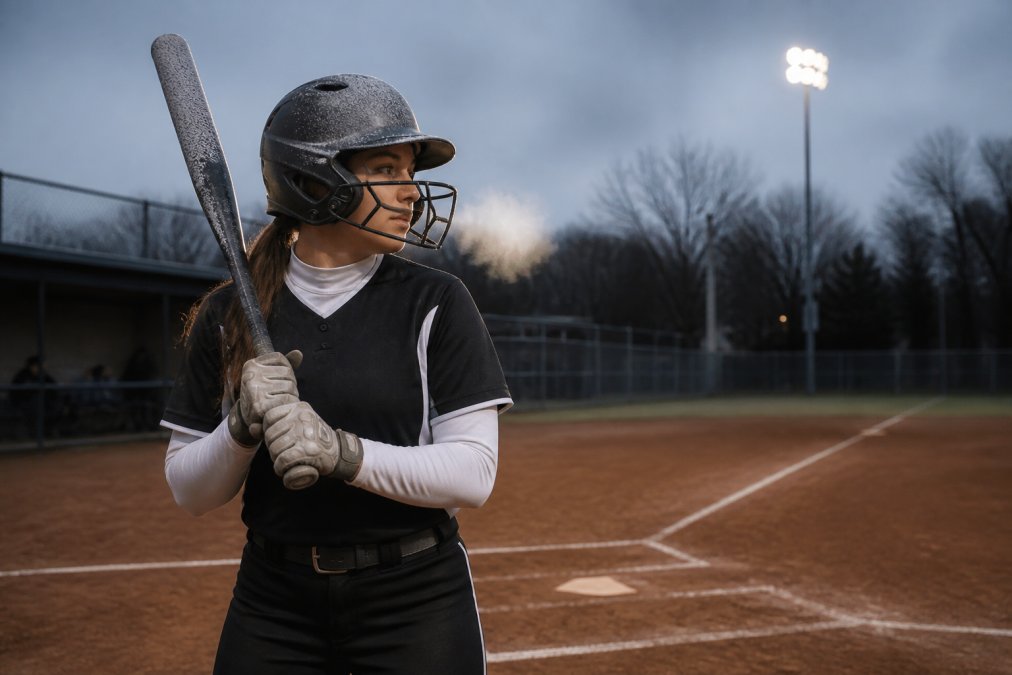
Below, we'll break down exactly what happens to your bat in cold weather and what you can do about it.
Ball Compression and Exit Velocity in Cold Weather
Ball compression changes dramatically in cold conditions. When a softball is cold, it becomes harder and denser. The outer covering contracts, and the interior materials lose their elasticity. This means the ball doesn't compress as much when it makes contact with the bat, which reduces the energy transfer and lowers exit velocity.
A cold ball bounces off the bat with less force than a warm one, translating directly to shorter hits and weaker contact. The coefficient of restitution, how much energy bounces back after impact, decreases in cold temperatures, and players notice this immediately in distance and feel.
Even if your bat is warm, a cold ball limits performance. This is why serious players warm up their bats and keep balls in heated equipment bags during tournaments.
Colder materials are less elastic, reducing energy transfer and exit velocity consistently across bat types.
Composite Bat Cold Weather Damage: Material Breakdown
Composite bats are especially vulnerable to cold because resin becomes brittle and loses flexibility, creating invisible micro-fractures that can lead to catastrophic failure.
Temperature danger zones for composite bats:
Composite materials experience measurable performance loss below 15°C (59°F), with the sweet spot shrinking 10-15%. Below 5°C (41°F), micro-fracture risk accelerates significantly. Below freezing, composite bats should not be used without extended warming. Rapid temperature swings, from heated vehicles to outdoor cold, cause thermal shock and material separation.
Why composite materials fail in cold:
Composite bats experience thermal contraction as temperature drops. Fiberglass and resin contract at different rates, creating internal stress and micro-fractures that remain invisible from the outside. Repeated impacts on a cold composite bat convert these micro-fractures into dead spots or full barrel cracks.
Humidity compounds the problem. Cold, dry air causes composite bats to lose moisture from the resin, increasing shrinkage and brittleness. Prolonged exposure to low temperature and low humidity can reduce bat lifespan by 20-30%.
Post-cold exposure recovery protocol:
If your composite bat has been accidentally left in freezing conditions or transported in an unheated vehicle, do not use it immediately. Follow this acclimation procedure:
-
Allow gradual warming (2-4 hours). Place the bat in a room-temperature environment (20-22°C). Do not use direct heat sources; thermal shock from rapid warming causes the same material stress as rapid cooling.
-
Inspect for visible damage. Examine the barrel for cracks, dents, or separation. Tap gently with your knuckles; a dull thud indicates internal damage.
-
Test with light contact before full play. Take 10-15 practice swings with controlled contact. If performance feels reduced or the bat sounds different, do not use it.
-
Store properly after recovery. Store in a climate-controlled space (20-22°C, 40-50% humidity) to prevent future cold exposure damage.
Composite bats exposed to extreme cold multiple times show cumulative damage. Serious players in cold climates often rotate composite bats seasonally, switching to alloy bats during fall and winter to extend equipment lifespan.
Alloy Bats and Temperature: Why Cold Affects Metal Performance
Alloy bats become harder and more brittle in cold, and understanding how temperature affects softball bat performance shows that barrel elasticity and exit velocity both reduce. The sweet spot shrinks, and the metal becomes prone to denting and stress fractures. Unlike composites, alloy bats don't experience resin-fiberglass separation, but performance loss is still noticeable. Serious players warm alloy bats before games, as every degree of temperature affects responsiveness and exit velocity.
HeatStik Softball Heated Bat Warmer →
How to Warm Up a Softball Bat Before Play
Warming up your bat before a game is the most direct way to maintain performance in cold weather. There are several methods, each with different levels of effectiveness.
Active warming involves taking practice swings indoors or in a sheltered area for 5-10 minutes to raise barrel temperature and loosen up mentally and physically. This method works but is time-consuming and requires indoor access.
Passive warming using an insulated bat sleeve is faster and more convenient. A heated bat warmer like the HeatStik Softball Heated Bat Warmer uses a USB-powered heating pad to maintain optimal barrel temperature between swings. Simply slip the sleeve onto your bat 10-15 minutes before you step up to the plate. The triple-layer construction, lightweight inner layer, heating pad with adjustable temperature settings, and water-resistant neoprene outer layer, keeps your bat warm and ready. This method is portable, requires minimal setup, and works consistently across different temperature conditions.

Timing matters. Don't warm your bat hours before you play. The barrel will cool down again while you wait. Warm it 10-15 minutes before your at-bat. If you're playing multiple games in a tournament, rewarm between games.
Environment affects results. If you're moving between an indoor facility and outdoor cold weather, keep your bat warm during the transition.
Storage and Maintenance: Preventing Cold-Induced Damage
How you store your bats during cold weather directly impacts their lifespan and performance. Proper storage prevents the material degradation that temperature fluctuations cause and is especially critical for composite bats, which are far more sensitive to environmental stress than alloy or wood bats.
Optimal storage conditions by material type:
| Bat Material | Ideal Temperature | Ideal Humidity | Storage Priority | Risk if Neglected |
|---|---|---|---|---|
| Composite | 20-22°C (68-72°F) | 40-50% | Critical | Micro-fractures, resin brittleness, delamination |
| Alloy | 15-22°C (59-72°F) | 30-60% | High | Denting, stress fractures, reduced elasticity |
| Wood | 18-22°C (64-72°F) | 35-55% | Moderate | Warping, splitting, moisture absorption |
Humidity control specifics:
Transport and transition management:
-
Use an insulated bat bag. A padded or neoprene bat bag provides thermal buffering, slowing the rate at which your bat cools during transport. This reduces thermal shock.
-
Keep bats in the passenger cabin, not the trunk. Vehicle trunks are unheated and can drop to near-ambient temperature. The passenger cabin, even if not heated, stays warmer than the trunk.
-
Avoid rapid transitions. Don't take a bat directly from a warm car into freezing outdoor air and immediately start swinging. Allow 10-15 minutes of gradual acclimation, or use a heated bat warmer to maintain barrel temperature during the transition.
HeatStik Heated Bat Warmer (Sleeve Only) -
Plan for multi-game tournaments. Between games, keep your bat indoors or in an insulated bag. Rewarming your bat between games (using active swings or a heated sleeve) restores performance and reduces cumulative cold exposure.
Seasonal inspection and maintenance checklist:
- Visual inspection: Look for cracks, dents, or areas where the barrel covering appears separated from the underlying material. Pay special attention to the sweet spot area, where impacts concentrate stress.
- Sound test: Tap the barrel gently with your knuckles. A clear, resonant ring indicates structural integrity. A dull thud or flat sound suggests internal damage or dead spots.
- Flex test (composite bats only): Gently flex the barrel by hand. It should feel slightly flexible, not rigid. Excessive stiffness indicates resin brittleness from cold exposure or age.
- Weight and balance check: Hold the bat at the knob and feel its balance point. Any shift in balance suggests internal material separation.
- Documentation: Keep a simple log of when your bats are used, stored, and inspected. This helps you track which bats have been exposed to cold and may need replacement sooner.
Recovery after winter storage:
When to retire a bat:
Frequently Asked Questions
What temperature is too cold for softball bats?
Softball and baseball bats begin to lose performance noticeably below 10°C (50°F). At subfreezing temperatures below 0°C (32°F), the impact is severe: ball compression drops significantly, reducing exit velocity by 10-15%, and composite materials become brittle, increasing the risk of micro-fractures and barrel cracking. Alloy bats remain safer at extreme cold but still experience reduced responsiveness. The colder the temperature, the greater the performance degradation and structural risk.
Why do composite bats crack more easily in cold weather?
Composite resin becomes less flexible in cold temperatures, losing elasticity and impact resistance. Cold reduces the material's ability to absorb and distribute kinetic energy from ball impact. Additionally, thermal contraction causes internal stress within the fiberglass reinforcement layers. When a cold bat makes contact with a ball, the sudden impact creates micro-fractures that can spread into visible cracks. Repeated impacts in cold conditions accelerate material fatigue and structural failure.
How does warming a softball bat improve performance?
Warming a bat restores the composite resin or alloy to closer to its designed operating temperature, improving coefficient of restitution and impact energy transfer. A warmed barrel responds more efficiently to swing mechanics, increasing ball exit velocity and sweet spot responsiveness. Thermal expansion of the material also reduces brittleness, lowering the risk of micro-fractures during play. Players report noticeably better contact consistency and power when using a pre-warmed bat in cold conditions.
Can I use a regular bat cozy instead of a heated bat warmer?
A passive insulated cover slows heat loss but cannot restore warmth to a cold bat. It maintains existing temperature but doesn't raise it. A heated bat warmer with adjustable temperature settings actively warms the barrel to optimal hitting temperature, delivering measurable improvements in exit velocity and performance. For competitive play in freezing conditions, active heating provides superior results compared to insulation alone, especially during breaks between innings when bats cool quickly.