
Winter Batting Alternatives: 7 Solutions Beyond Indoor Cages
Table of Contents
- Why Winter Batting Alternatives Matter for Your Game
- Heated Bat Sleeves: Direct Performance Solutions for Cold Weather
- DIY Basement Batting Cage Setup for Year-Round Training
- Maintaining Composite Bat Performance in Winter Conditions
- Cold Weather Baseball Training Tips and Drills
- Garage and Limited-Space Hitting Stations
- Soft Toss, Tee Work, and Swing Mechanics in Winter
- Conclusion: Choosing Your Winter Training Path
- Frequently Asked Questions
Last Updated: September 25, 2026
Why Winter Batting Alternatives Matter for Your Game
Cold weather destroys bat performance. When temperatures drop, composite and alloy bats lose responsiveness, sweet spot consistency suffers, and exit velocity drops noticeably. For competitive players, winter batting alternatives become essential.
Winter batting alternatives extend your training season without sacrificing performance. Whether you're preparing for early-season tournaments, maintaining swing mechanics, or coaching a travel team through cold-weather play, having multiple training options keeps your competitive edge sharp.
The right winter batting alternatives depend on your access to space and budget. This guide covers practical solutions: heated bat sleeves, DIY setups, maintenance strategies, and cold-weather drills.

Heated Bat Sleeves: Direct Performance Solutions for Cold Weather
A heated bat sleeve solves the core problem directly: it keeps your bat at optimal temperature between swings, maintaining responsiveness throughout practice and tournament play.
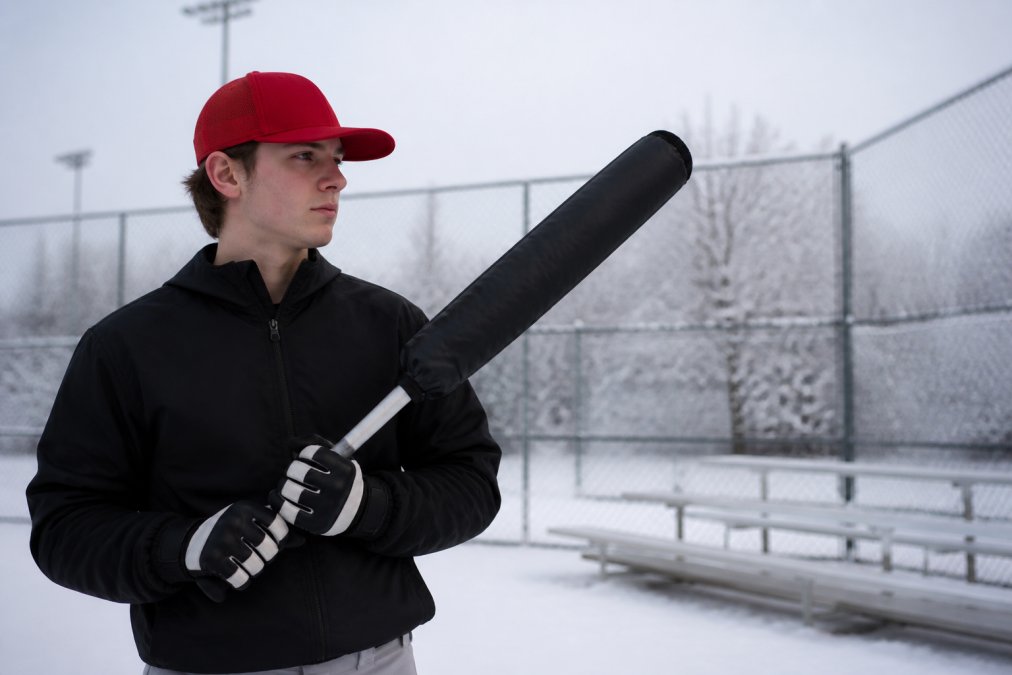
Heated bat sleeves use USB-powered heating pads in triple-layer construction: smooth inner layer, adjustable heating element, and water-resistant neoprene outer layer. A 30,000mAh power bank provides hours of consistent warmth for full tournament days.
The Heatstik Heated Bat Warmer represents this category's practical approach. For softball players, the standard version fits bats up to 5.7 cm (2.25 inches) and costs $129.99 with the power bank included, or $74.99 for the sleeve alone. For hardball players using larger-diameter bats, the Apex Hardball model accommodates up to 7.6 cm (3-inch) barrels at $149.99 complete or $74.99 for the sleeve. Both use three adjustable temperature settings, so you control how much warmth your specific bat needs.

The advantage is immediate: slip on the sleeve, activate the heating pad, and maintain bat temperature between at-bats. The sleeve rolls up easily and fits in any equipment bag.
A 30,000mAh power bank runs the heating pad for several hours, but tournament days with multiple games demand backup power. The Heatstik Diamond Power Pack™ ($79.99) offers a 30,000mAh capacity, 22.5W fast charging, a convenient digital battery display, and four built-in charging cables for recharging between games.
DIY Basement Batting Cage Setup for Year-Round Training
A basement or garage hitting station eliminates weather dependency. You control the environment, lighting, and training focus, delivering consistent swing work access year-round.
Basic setups start with knotted nylon netting rated for impact resistance. Mount netting securely to walls or frame with PVC pipe if renting.
LED shop lights overhead eliminate shadows and provide consistent illumination. A fixed background helps with pitch recognition. Basic lighting and netting costs under $200.
Basement training enables repetition focus without outdoor distractions. Limited-flight balls and safety balls let you work in confined spaces. Foam and reduced-flight training balls are lighter and slower than regulation baseballs, ideal for basement work.
Basement training with limited-flight balls removes the cold-weather variable. Your bat performs normally at room temperature, letting you focus on swing mechanics and hit consistency.
Maintaining Composite Bat Performance in Winter Conditions
Cold-weather maintenance prevents damage that shows up later. Composite bats are vulnerable because cold makes resin brittle and reduces sweet spot responsiveness.
Store composite bats indoors at room temperature, never in unheated vehicles. Bring bats inside immediately after cold-weather play and let them warm gradually. Rapid temperature swings stress composite material.
Inspect bats for hairline cracks after cold-weather play. Run your hand along the barrel looking for rough spots or visible stress marks. Small cracks that seem minor now expand with continued use. Catching damage early means replacing a bat before it fails during an important at-bat.
For alloy bats, cold weather is less destructive, but performance still drops. Warming the bat before play, even just holding it indoors for 10 minutes before stepping into the batter's box, restores more consistent contact.
Bat bags with insulation offer passive protection. They keep bats closer to ambient temperature and buffer against sudden cold exposure. Pair this with a heated bat sleeve for active temperature control, and you've addressed both storage and game-day performance.
HeatStik Softball Heated Bat Warmer →
Cold Weather Baseball Training Tips and Drills
Winter batting alternatives work best when paired with cold-weather specific drills. Some training methods compensate for reduced bat performance, while others build skills that transfer directly to warm-weather play.
Soft toss drills work exceptionally well in cold weather. A coach or partner throws from 9 to 12 metres (30-40 feet), and you focus on contact consistency and swing path. You're training hit location, timing, and mechanics, skills that carry over to any temperature.
Tee work indoors or in protected areas lets you work on specific swing mechanics without weather interference. Set up multiple tee heights to practice hitting different pitch zones. With a fixed tee, you eliminate the pitcher variable and focus purely on your swing. This builds muscle memory that improves consistency when conditions improve.
Limited-flight ball training develops swing consistency without requiring full-sized fields. Safety balls and foam balls are lighter and slower, making them ideal for garage or basement work. The reduced velocity actually helps in cold weather; you can focus on contact quality.
Pitch recognition drills transfer well to cold-weather training. Using video training systems or recorded pitch sequences, you practice recognizing pitch types and location without weather being a factor.
| Drill Type | Best For | Equipment Needed | Winter Advantage |
|---|---|---|---|
| Soft toss | Contact consistency, swing path | Soft toss machine or partner | Removes velocity variable |
| Tee work | Swing mechanics, zone awareness | Batting tee, balls | Completely controlled environment |
| Limited-flight balls | Repetition in confined spaces | Safety balls, garage setup | No weather delays, unlimited reps |
| Pitch recognition | Mental preparation, timing | Video system or recorded pitches | Develops skills independent of equipment |
Garage and Limited-Space Hitting Stations
Not every player has basement access. Garage setups offer a practical alternative for year-round training in tight spaces. A single-car garage provides enough room for tee work and soft toss drills.
Space-saving retractable cages fold up against the wall when not in use, freeing garage space for vehicles or storage. These systems use lightweight netting and collapsible frames. Setup takes minutes, and they store in minimal space.
Garage heating solutions range from simple to sophisticated. A propane blower heater warms the space quickly for practice sessions. Thermal insulation on walls and doors minimizes heat loss. For serious year-round training, a small space heater on a timer can maintain baseline temperature without expensive installation.
Controlled lighting in a garage hitting station improves swing consistency. LED shop lights provide shadow-free illumination. A fixed background, even a simple tarp, helps with pitch recognition and visual consistency.
Limited-space drills adapt to garage dimensions. Soft toss from 7.5 to 9 metres (25-30 feet) works in a single-car garage. Tee work requires minimal space. Swing path drills using video analysis need only enough room to stand and swing. The constraint forces focus; you're working specific skills.
Soft Toss, Tee Work, and Swing Mechanics in Winter
These three drilling methods form the foundation of effective winter training. Each addresses different aspects of hitting while accommodating cold-weather limitations.
Soft toss develops hitting consistency under realistic conditions. A coach or partner throws underhand from 10.5 to 12 metres (35-40 feet), and you focus on timing and contact.
Conclusion: Choosing Your Winter Training Path
Winter doesn't have to mean lost training time. The alternatives to indoor batting cages range from direct solutions like heated bat sleeves to comprehensive setups like basement or garage hitting stations. The right choice depends on your access to space, your budget, and your specific training goals.
Frequently Asked Questions
How can I practice hitting at home during the winter?
Set up a DIY hitting station in your basement or garage using a tee, soft toss machine, or batting net. Ensure adequate ceiling height (at least 3.5 metres for baseball) and use limited-flight balls to prevent damage. Many players also use heated bat sleeves to maintain composite bat responsiveness during cold-weather training sessions at home.
What are the benefits of using a heated bat sleeve for cold-weather practice?
Heated bat sleeves like the HeatStik Heated Bat Warmer ($129.99 for softball, $149.99 for hardball) restore bat barrel responsiveness by keeping your bat at optimal temperature. Cold reduces exit velocity and sweet spot performance in composite and alloy bats. A heated sleeve with a 30,000mAh power bank provides hours of consistent warmth between swings, ensuring your bat performs the same whether you're training indoors or playing in early-season cold games.
How do I prevent composite bat damage during winter training?
Keep composite bats warm before and between swings using a heated bat sleeve. Store bats indoors at room temperature rather than in cold vehicles or outdoor storage. Use limited-flight balls or safety balls for indoor practice to reduce impact stress. Rotate between multiple bats to minimize repeated stress on any single barrel during winter training.
Can I build a DIY hitting station in my basement or garage?
Yes. You'll need a tee, batting net or cage netting (knotted nylon design for impact resistance), and enough ceiling clearance (3.5+ metres for baseball, 3 metres for softball). Install fixed background targets to track pitch recognition and swing path. Use limited-flight balls to contain the training area. Many coaches recommend starting with soft toss and tee work before progressing to machine-fed or live pitching in confined spaces.
What's the difference between a heated bat sleeve and a regular bat cover?
A regular insulated bat cover provides passive temperature retention but cannot actively warm a cold bat. A heated bat sleeve like HeatStik uses a built-in heating pad with adjustable temperature settings and USB power to actively restore barrel warmth. This active heating maintains swing consistency and exit velocity, whereas passive covers only slow heat loss from an already-cold bat.