
Does Cold Weather Affect Composite Bat Performance?
Last Updated: October 23, 2026
Quick Summary
Cold weather affects composite bat performance by stiffening the barrel, which shrinks the sweet spot, while the chilled ball gets harder and sends more shock into the barrel. Most composite bats become a real risk below roughly 10°C, and many manufacturers recommend avoiding composite use at or below freezing. The damage often shows up later, not on the swing that caused it.
- Cold hurts composite bats twice: it stiffens the barrel and hardens the ball, raising impact stress and cutting pop.
- Above 15°C response is normal; 4-10°C carries high cracking risk on mishits; below 4°C avoid composite if possible.
- Store your bat indoors, warm it before the first swing, and keep it covered between innings.
- Inspect after every cold-weather game for hairline cracks, flat sounds, and soft spots that do not spring back.
- Most composite bat warranties exclude damage from use below the manufacturer's stated temperature.
Table of Contents
- Does Cold Weather Affect Composite Bat Performance?
- Why Composite Bats Are More Vulnerable to Cold
- What Temperature Is Too Cold for a Composite Bat?
- Can Cold Weather Damage a Composite Bat?
- Composite vs Alloy Bats in Cold Weather
- How to Keep a Composite Bat Warm: Pregame and In-Game Steps
- Inspecting Your Bat After Cold-Weather Play
- Conclusion
- Frequently Asked Questions
Does Cold Weather Affect Composite Bat Performance?
Yes. Cold weather affects composite bat performance in two ways simultaneously. The barrel stiffens, shrinking the sweet spot, and the ball becomes harder, sending more shock into the stiffer barrel. This guide from Heatstik breaks down what happens to a composite bat in the cold, when it becomes a real risk, and how to keep your barrel game-ready.
Here is the part most players miss: the performance drop is only half the story. The other half is damage.
A composite barrel is built to flex and snap back on contact. Cold takes that flex away. The bat behaves like a plank instead of a spring. Meanwhile, a chilled ball does not compress the way a warm one does, so the same swing puts far more stress on the barrel wall.
Below, we explain what temperature is too cold, how to keep a composite bat warm, and the pregame steps that protect your investment.
Why Composite Bats Are More Vulnerable to Cold
Composite bats are more vulnerable to cold because their performance depends on the resin and fiber layers flexing together. Cold makes those layers stiffer and less forgiving.
Think about what a composite barrel actually is. It is layers of fiber bonded in resin, shaped into a thin wall. That wall is designed to give slightly on impact, then spring back. That flex is where the pop comes from.
Cold changes the math. The resin stiffens. The layers lose some of their give. Now the barrel is not flexing as designed, so energy that should transfer to the ball goes into the wall instead.
Alloy bats handle this better. Metal is more uniform and has more natural give at low temperatures. Composite construction is thinner and more tuned, which is exactly why it performs so well in warm conditions and struggles in frigid temperatures.
- Composite: thin, tuned wall, best pop when warm, less tolerant of cold
- Alloy: uniform metal, more predictable in low temperatures, less peak pop
- The cold-weather gap between them is real, and it grows as the temperature drops
What Temperature Is Too Cold for a Composite Bat?
Most composite bats become a real risk below roughly 10°C, and many manufacturers recommend avoiding composite use at or below freezing. The exact threshold depends on your bat's certification and the maker's guidance.
There is no single number that applies to every bat.
| Temperature | Risk Level | What to Expect |
|---|---|---|
| Above 15°C | Low | Normal composite response; ball compresses as designed |
| 10-15°C | Moderate | Stiffer barrel, smaller sweet spot; ball starting to firm up |
| 4-10°C | High | Real cracking risk on mishits; ball noticeably harder |
| Below 4°C | Very high | Avoid composite if possible; ball behaves like a rock |
Manufacturer limits vs. rules of thumb. The table above is a rule of thumb, not a warranty term. Manufacturers publish their own cold-weather guidance, and that always outranks a general number.
Certification matters too. A bat certified for one league or sanctioning body may carry different care expectations than another. As a rule of thumb from Baseball Canada's equipment guidance, cold-weather play calls for extra care with composite equipment.
The ball is half the equation. A common mistake is to assume the bat is the only variable. Cold changes the ball as well.
Construction changes the margin. One-piece composite barrels and two-piece composite barrels do not fail identically.
The temperature threshold is not about comfort. It is about how much flex the barrel has left, and how hard the ball is when it arrives.
Can Cold Weather Damage a Composite Bat?
Cold weather can damage a composite bat, and cracking is the most common failure. The barrel wall takes stress it was not designed to absorb, and small failures spread.
Here is how it usually happens. A player takes a swing off the end of the barrel. In warm weather, the wall flexes and recovers. In the cold, the wall is stiff, so the same contact concentrates force in one spot. A hairline crack starts there.
You may not notice it that inning. Then a week later, the barrel gives out.
- Barrel cracking along the fibers
- Dents and soft spots that do not spring back
- A dead, flat sound on contact
- Visible spidering near the sweet spot
The cold ball matters here too. A chilled ball does not compress, so more of the impact energy goes straight into the barrel. That is why cold-weather contact damages bats faster than warm-weather contact at the same swing speed.
HeatStik Softball Heated Bat Warmer →
Composite vs Alloy Bats in Cold Weather
Alloy bats are the safer choice in cold weather, but composite bats can still be used with the right care. The difference comes down to how each material handles impact stress.
An alloy bat is one piece of metal. It dents when overloaded, and a dent is usually obvious. You can see the damage and stop using it.
A composite bat fails differently. The wall can crack internally before you see anything. That makes it harder to catch and riskier to ignore.
- Choose alloy when the temperature is near or below freezing
- Choose composite when you can keep the barrel warm between swings
- Never assume a composite bat is fine just because it looks fine
If you are playing fall ball or an early-spring tournament, this decision matters more than which bat has the better spec sheet.
How to Keep a Composite Bat Warm: Pregame and In-Game Steps
Keeping a composite bat warm comes down to three things: store it indoors, warm it before play, and hold that heat between innings. A heated bat sleeve does the third job best.
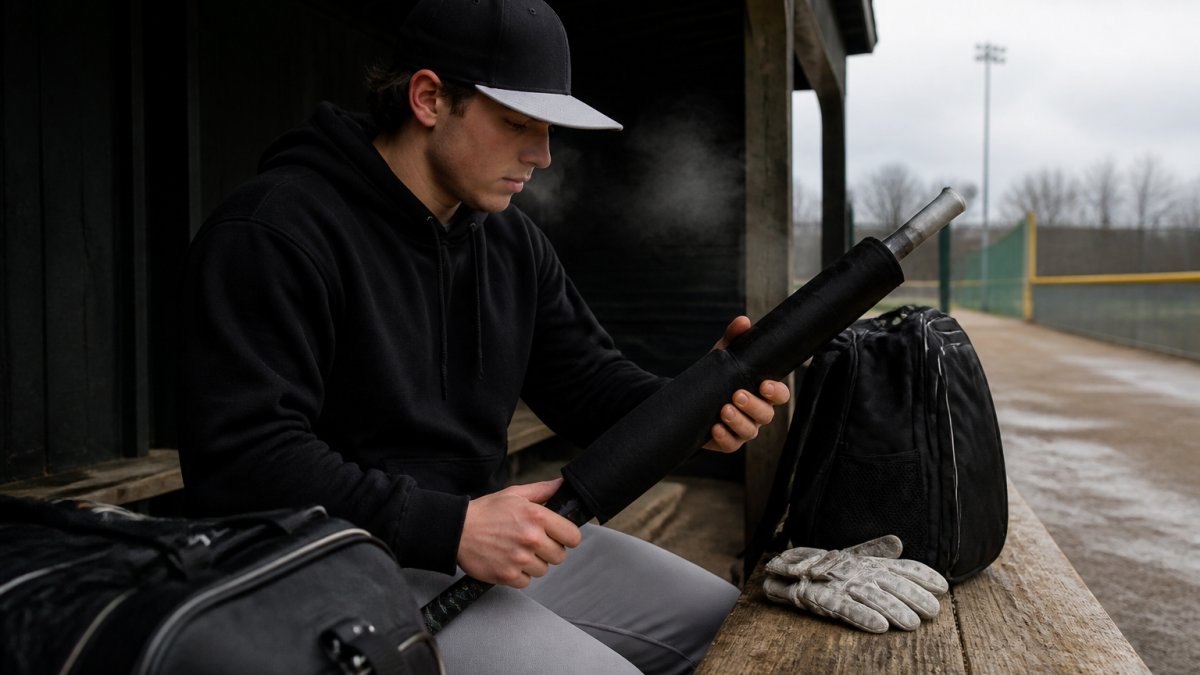
Here is the routine we recommend.
- Store it indoors. Never leave a composite bat in a cold car or garage overnight. Let it start the day at room temperature.
- Warm it before the first swing. Give the barrel time to reach a stable, warm temperature before you hit.
- Keep it covered between innings. Heat escapes fast in cold air. A sleeve holds it in.
- Warm up with the bat you will game. Do not warm up with one bat and switch.
- Keep it off the cold ground. Set it on your bag, not the dirt or bench.
- Re-heat between at-bats. A bat that sat out for two innings is a cold bat again.
This is where the Heatstik heated bat warmer earns its place. It uses a USB-powered heating pad with three temperature settings, wrapped in water-resistant neoprene. It runs off a 30,000mAh power bank, so it holds heat for hours between swings. The Heatstik heated bat warmer fits bats up to 2 1/4 inches, and the Apex model fits up to 3 inches for hardball.

Inspecting Your Bat After Cold-Weather Play
Inspect your composite bat after every cold-weather game, even if it felt fine.
Run through this checklist:
- Wipe the barrel clean and look for hairline cracks
- Tap the barrel lightly and listen for a flat or dead sound
- Feel for soft spots or dents that do not spring back
- Check the taper and handle for stress marks
- Compare the sound to how the bat sounded when new
What the signs actually mean. A hairline crack along the fibers is the classic cold-weather failure; it often starts near the end of the barrel where mishits concentrate force.
When to stop using the bat. If you find a crack, a dead spot, or a soft spot that does not spring back, stop using the bat immediately.
Check the warranty before you need it. Most composite bat warranties exclude damage from use below the manufacturer's stated temperature, and some require proof of purchase and a return authorization.
Construction-specific failure modes. One-piece composite bats tend to fail along the barrel wall or at the taper.
After the game, not just after the season. Cold damage compounds.
The NFHS rules on bat standards and your league's equipment policy set the compliance side. Your own inspection handles the safety side.
Conclusion
Cold weather is hard on composite bats, and the damage is often invisible until it is too late. You can still play through it with the right routine.
Heatstik was built for exactly this problem. Our heated bat sleeve keeps your barrel at hitting temperature with a triple-layer insulated design, three heat settings, and a 30,000mAh power bank that lasts hours. It fits both composite and alloy bats, so your whole equipment bag is covered.
Get started with Heatstik and step into the box with a warm, responsive barrel, whatever the forecast says.
Frequently Asked Questions
What is too cold to use a composite bat?
Most composite bat makers publish a cold-weather limit, and a common cutoff is around 10°C. Below that, the ball stiffens and the barrel takes harder impacts, so the risk of cracking climbs. Treat 10°C as the point to start extra care, not a magic number. Check your specific bat's warranty terms, because some manufacturers void coverage for use below a stated temperature. If you play in near-freezing conditions, keep the barrel warm between innings and avoid using the bat for cold-weather batting practice.
How do you keep a composite bat warm in cold weather?
Store the bat indoors until you leave for the field, then keep it out of the trunk and off cold ground. Between innings, slide it into an insulated sleeve rather than leaving it on the bench or in a dugout rack. A heated bat warmer such as the HeatStik, which runs off a 30,000mAh USB power bank, holds the barrel near hitting temperature for hours. Never heat a bat with open flame, a car heater vent, or hot water, since uneven heat can damage the resin.
Can cold weather damage a composite bat even if it doesn't crack right away?
Yes. Damage is often cumulative. A cold ball compresses less on impact, so more of the force transfers into the barrel wall. That can create micro-fractures in the composite layers that stay invisible until a later swing opens them into a crack or a dead spot. A bat that survived a cold tournament may still lose pop weeks later. Inspect the barrel after every cold-weather session and retire any bat that sounds flat or shows surface webbing.
Does a composite bat have a different cold-weather limit than an alloy bat?
They behave differently. Aluminum and alloy barrels are metal and flex rather than fracture, so they tolerate cold with less cracking risk, though they can dent. Composite barrels are layered fiber and resin, which gets brittle as temperature drops, making cracking the main concern. That is why many composite warranties exclude cold-weather use while alloy warranties rarely do. If you play a lot of early-spring or late-fall games, an alloy bat for those dates and a composite for warmer ones is a practical split.
